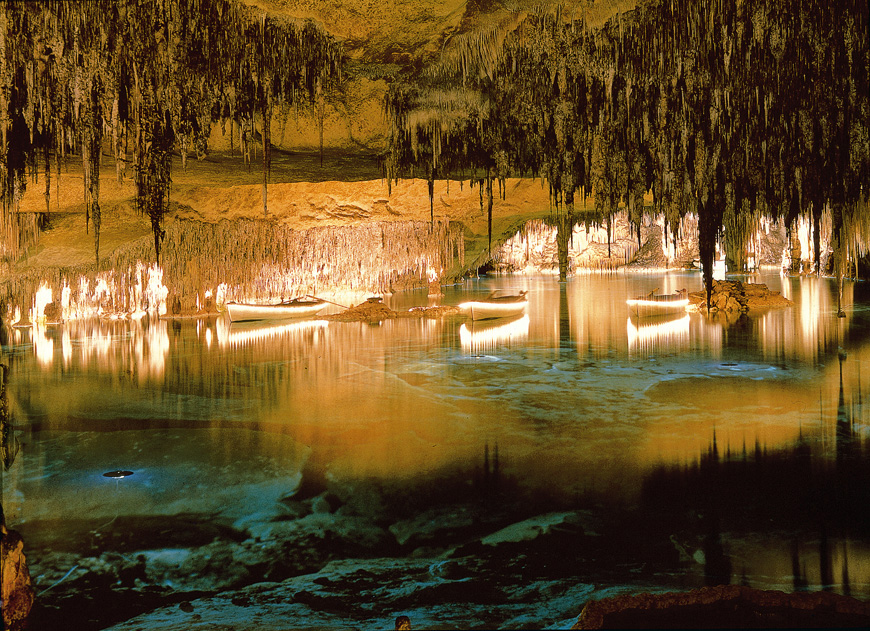
Perched on a hillside just east of the seaside town of Nerja in the province of Malaga, the Cueva de Nerja is one of Spain's most visited natural attractions. Stretching nearly five kilometres into the limestone bedrock of the Sierra Almijara, the cave contains extraordinary geological formations and evidence of human habitation stretching back at least 25,000 years. It is a place where natural history and human archaeology converge in a space of remarkable beauty.
An Accidental Discovery
The modern story of Cueva de Nerja begins on 12 January 1959, when a group of five local teenagers went exploring a sinkhole called La Mina, hoping to find bats. Instead, they stumbled upon a narrow passage that led into a vast underground gallery. Word spread quickly, and within weeks, the Malaga Provincial Government sent geologists and archaeologists to assess the find.
What they discovered exceeded all expectations. The cave contained enormous chambers filled with massive stalactite and stalagmite formations, alongside prehistoric paintings and artefacts scattered across multiple levels. Within three years, portions of the cave were opened to the public, and it has remained one of the region's most important cultural and geological sites ever since.

Geological Formations
The cave's primary geological feature is its sheer scale. The Hall of the Cataclysm, the largest accessible chamber, measures approximately 100 metres in length and reaches heights of over 30 metres in places. It is within this chamber that you will find what has been described as the tallest column formation in the world, a merged stalactite and stalagmite measuring around 32 metres from floor to ceiling.
Beyond the column, the cave is filled with an extraordinary variety of speleothems. Delicate soda straw stalactites hang alongside thick drapery formations. Flowstone cascades line the walls in places, while rimstone pools collect mineral-rich water in shallow terraces. The colour palette ranges from brilliant white calcite to deep amber and rust tones, depending on the mineral content of the water that created each formation.
Prehistoric Art and Archaeology
Cueva de Nerja holds considerable archaeological importance. Evidence suggests that humans inhabited or used the cave during the Upper Paleolithic and Neolithic periods. Researchers have found charcoal remains, stone tools, bone fragments, and shell ornaments across multiple excavation layers.
The cave paintings, located in areas not currently open to the public for conservation reasons, include depictions of seals, fish, and abstract symbols. In 2012, a research team announced the possible discovery of paintings dating back approximately 42,000 years, which, if confirmed, would make them among the oldest known works of art by Neanderthals. This claim remains under peer review and has generated significant academic discussion.
The Summer Festival
Each year, the Nerja Festival of Music and Dance uses the cave's Cascade Chamber as a natural performance space. The annual programme typically runs in July and features classical music, flamenco, and ballet performances. The acoustics inside the cave, shaped by the same natural processes that created its formations, provide a sound quality that purpose-built concert halls struggle to replicate. The official Cueva de Nerja site publishes the festival calendar each spring.
Visitor Information
- Location: Carretera de Maro, s/n, 29787 Nerja, Malaga
- Opening Hours: Open daily; summer hours 9:30 to 19:00, winter hours 9:30 to 16:00 (last entry 1 hour before close)
- Tour Duration: Approximately 45 minutes along the public route
- Temperature Inside: Around 19 degrees Celsius year-round
- Accessibility: The main path is paved but involves some steps and uneven surfaces. The cave is partially accessible for visitors with mobility limitations.
- Photography: Permitted throughout the public galleries; flash photography is not allowed.
Reaching Cueva de Nerja
The cave is situated approximately 4 kilometres east of Nerja town centre and 50 kilometres east of Malaga city. If driving from Malaga, take the A-7 coastal motorway eastward; the journey takes about 45 minutes. A free car park is located at the site entrance.
Public buses connect Malaga city with Nerja regularly throughout the day, with the journey taking approximately one hour. From Nerja's bus station, a local minibus service runs to the cave during the summer season. Outside of summer, the walk from town to the cave entrance takes about 40 minutes along a mostly flat road.
What to See Nearby
The town of Nerja itself is one of the most pleasant stops on the Costa del Sol. The Balcon de Europa, a palm-lined promenade jutting out above the sea on a rocky headland, offers panoramic views of the coastline and the distant Sierra Nevada on clear days. Below the promenade, small coves with clear water provide excellent swimming.
A short drive west brings you to Frigiliana, a whitewashed hill village often cited as one of the prettiest in Andalusia, with narrow cobbled streets, ceramic-decorated facades, and views over the surrounding mountains. The Spain Tourism Board maintains updated regional guides for the area.