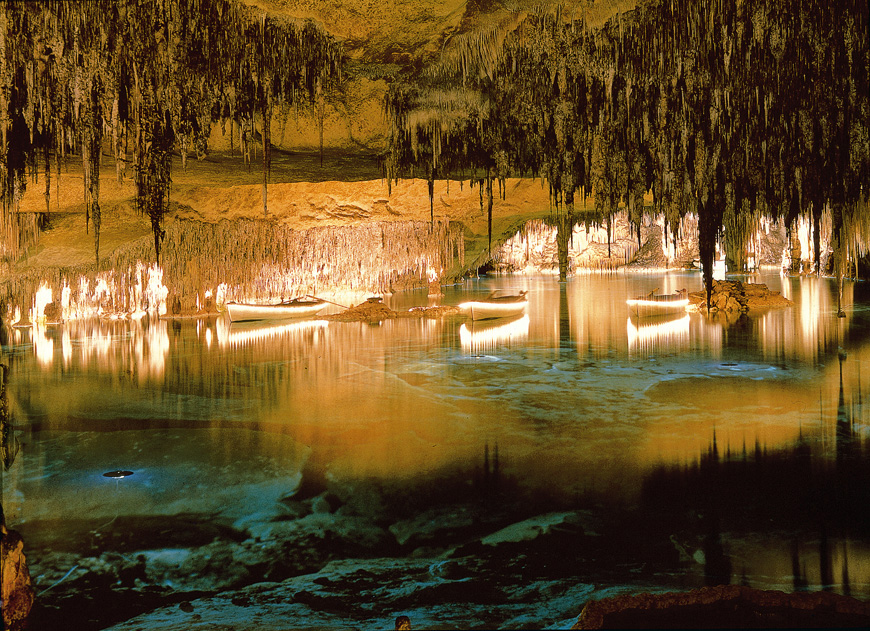
Hidden beneath the limestone hills of Vall d'Uixo in Castellon province, Coves de Sant Josep is home to the longest navigable underground river in Europe. Visitors explore the cave system primarily by boat, gliding along a subterranean waterway whose origin and ultimate end remain unknown. It is one of Spain's most distinctive cave experiences, combining geological beauty with a deep archaeological heritage that stretches back over 15,000 years.
A River Without End
The underground river within Coves de Sant Josep has been partially mapped to a length of approximately 2,750 metres, making the cave the longest in Castellon province and the second longest in the Valencian Community. Yet the full extent of the river system remains a mystery, as the passage narrows beyond the explored sections, preventing further exploration with current methods.
The river flows steadily through a series of interconnected galleries, maintaining a remarkably constant temperature of around 20 degrees Celsius throughout the year. This thermal stability, combined with the high humidity, creates a microclimate that has preserved both the geological formations and the archaeological remains within the cave to an exceptional degree.

Geology of the Cave
The cave formed during the Middle Triassic period, approximately 240 million years ago, as water slowly dissolved the limestone bedrock of the region. The process, known as karstification, created a complex network of channels, chambers, and galleries that continues to evolve today as the river gradually reshapes its course.
The geological formations inside are varied and well-preserved. Visitors will see stalactites descending from the ceiling, some of which have merged with rising stalagmites to form columns. Flowstone curtains drape along the walls in several sections, while the riverbed itself reveals smooth, water-polished limestone in shades of grey, cream, and amber. The lighting installed for the tourist route highlights these features without overwhelming the natural atmosphere of the space.
Human History at the Cave Entrance
Archaeological evidence suggests that the area around the cave entrance has been used by humans for at least 15,000 years. Near the mouth of the cave, researchers have identified rock paintings and engravings from the Magdalenian period, the final phase of the Upper Paleolithic. These include abstract marks, linear patterns, and possible animal representations, all executed in red ochre and charcoal.
The site is classified as a Cultural Interest Site under Spanish heritage law and is recognised as part of the UNESCO World Heritage listing for Rock Art of the Mediterranean Basin. This designation places Coves de Sant Josep alongside dozens of other Iberian sites that together form one of the most significant concentrations of prehistoric art in the world.
The Boat Tour Experience
The standard visit to Coves de Sant Josep combines a boat ride with short walking sections along elevated platforms. Small, flat-bottomed boats carry groups of visitors along the river, guided by an operator who points out notable formations and explains the cave's history. The boat ride covers roughly 800 metres of the accessible river section.
The pace is gentle and unhurried, allowing time to observe the rock formations from close range as the boat passes through galleries of varying widths. In some sections, the ceiling descends to within a metre of the water, creating an intimate passage before opening again into broader chambers. The effect is immersive and theatrical, enhanced by carefully positioned lighting that shifts between warm and cool tones.
Visitor Information
- Location: Paraje de Sant Josep, s/n, 12600 Vall d'Uixo, Castellon
- Opening Hours: Open daily; hours vary by season. Summer: 10:00 to 19:30. Winter: 11:00 to 13:30 and 15:30 to 17:00.
- Tour Duration: Approximately 40 minutes, including the boat ride and walkway sections
- Temperature Inside: Constant 20 degrees Celsius
- Accessibility: The boat tour is accessible for most visitors. Specific requirements should be discussed with staff before arrival.
- Special Tours: Night kayak tours and speleology experiences are available during certain periods. Check the official website for current availability.
Getting There
Vall d'Uixo is located about 50 kilometres north of Valencia city and 30 kilometres south of Castellon de la Plana. By car, the cave is accessible from the AP-7 motorway, with the journey from Valencia taking approximately 40 minutes. A car park is available at the site.
By public transport, regular train services connect Valencia and Castellon with Vall d'Uixo station, from which the cave is about a 15-minute walk. Bus connections are also available, though they run less frequently outside of peak season.
What to Do Nearby
The town of Vall d'Uixo itself has a compact old quarter with narrow streets, traditional architecture, and a handful of local restaurants serving Valencian cuisine. The surrounding area is known for its orange groves and the Sierra de Espadan natural park, which offers excellent hiking trails through forested hills with panoramic views of the Mediterranean coast.
The coastal town of Sagunto, about 25 kilometres south, features a well-preserved Roman theatre and a hilltop castle with roots stretching back to the Iberian period. For those interested in combining cave visits, the Coves de l'Or near Beniarres offer another fascinating glimpse at the region's underground heritage.